December 14, 2011

The Hemingway Paradigm Is… "bull-fights, bandits and black eyes"

In a previous entry I quoted a book by Richard Ford, Gatherings from Spain, and mentioned Ford's provocative, yet succinct characterization of the common Anglophone stereotypes of Spain as "bull-fights, bandits, and black eyes." Since this is my 50th entry, I thought I would mark the occasion, returning to the theme of the "Hemingway paradigm," by sharing with you the fuller excerpt from Ford's book. It's fascinating both for images of Spain in it that still resonate today, and also for its stereotypes that, in their dated, blatant or bald form, help underscore the intransigent nature of many Anglophone clichés about Spain which have somehow persisted despite the intervention of more than 150 years of history and dramatic social change.

I direct your attentions to Chapter XX of Richard Ford, Gatherings from Spain (1846) [all textual references here are made to the PDF version available at this link], whose opening summary of contents reveals much:
"What to observe in Spain—How to observe—Spanish Incuriousness and Suspicions—French Spies and Plunderers—Difficulties; How Surmounted—Efficacy of Passports and Bribes—Uncertainty and Want of Information in the Natives."
"Spanish Incuriousness and Suspicions," oh my! The fact that Chapter XX is preceded by a chapter on "The Spanish Figaro," a taxonomy of facial hair and other Barber Shop barbarities (yes, as in the barber of Seville), and followed by "Origin of Bull-fight or Festival, and its religious Character," also says much.

The excerpt that especially caught my attention in this chapter is from the section on "How to observe":
"The country is little better than a terra incognita, to naturalists, geologists, and all other branches of ists and ologists. Every where there, the material is as superabundant as native laborers and operatives are deficient. All these interesting branches of inquiry, healthful and agreeable, as being out-of-door pursuits, and bringing the amateur in close contact with nature, offer to embryo authors who are ambitious to book something new, a more worthy subject than the old story of dangers of bull-fights, bandits, and black eyes. Those who aspire to the romantic, the poetical, the sentimental, the artistical, the antiquarian, the classical, in short, to any of the sublime and beautiful lines, will find both in the past and present state of Spain, subjects enough in wandering with lead pencil and note-book through this singular country, which hovers between Europe and Africa, between civilization and barbarism ; this land of the green valley and barren mountain, of the boundless plain and the broken sierra ; those Elysian gardens of the vine, the olive, the orange, and the aloe ; those trackless, vast, silent, uncultivated wastes, the heritage of the wild bee ; in flying from the dull uniformity, the polished monotony of Europe, to the racy freshness of that original, unchanged country, where antiquity treads on the heels of to-day, where Paganism disputes the very altar with Christianity, where indulgence and luxury contend with privation and poverty, where a want of all that is generous or merciful is blended with the most devoted heroic virtues, where the most cold-blooded cruelty is linked with the fiery passions of Africa, where ignorance and erudition stand in violent and striking contrast." (pp. 268-269)
Where to start? Perhaps with Ford's homage to the agrarian, Mediterranean floraEvery time my in-laws take me out to some rural road or country trail, I'm continually startled to find that thyme and rosemary grow as wild weeds here! Our (European) culinary traditions live in the hills of many Spanish regions as "indigenous" flora, harkening back to the Ancient World... the Etruscan, then Greek, and finally Roman sea invaders. "Those Elysian gardens of the vine, the olive, the orange, and the aloe," what a wonderful way to capture that! The funny thing is that, 150 years later, and Ford might still find a need to coax his fellow Brits away from bullfights and beaches into the Spanish hills and pastureland. While rural tourism is quite popular among Spaniards, it is often not really appreciated by visiting tourists (with the possible exception of agritourism and visiting vineyards), who tend to focus more on the more peopled areas of pueblos, cities, or beach urbanizaciones. In this passage, Ford captures something true about Spain as a cultural and geographical crossroads, but falls back on the convenient dualism of placing it between fully European (domesticated, civilized) versus a (still barbaric) Africa. (Or Middle East: at times Ford describes Spaniards as "Oriental," recurring to a kind of "orientalism" which would leap off the pages of an Edward Said critique.)

Elysian gardens? This photo was among those submitted by the Fundación Dieta Mediterranea
in its (eventually successful) bid to include the Mediterranean diet as one of
UNESCO's protected "Intangible Cultural Heritage"

Spices grow like weeds! I took these photos of thyme or "tomillo" (left) and
camomile (right), "manzanilla", growing alongside the highway
the other day on our day trip to the Sierra de Gúdar.

Being myself trained more in the history of science, I also rather like (in the scholarly sense of the word "like," which is to say "want to heavily deride") another (problematic) subtext of this passage: that Spaniards themselves make for poor scientists naturalists and have thus failed to appreciate their own natural splendor. Here Ford is brushing up against a subject which seems to touch a nerve with Spaniards, in what at times feels to me like an "inferiority complex" in Spanish science… It takes the form of constant comparison to other countries ("as good as French X…") or constant reference to international standards and recognition at the expense of appreciating local acclaim ("Dr. Y is _globally_ recognized as one of the best Z scientists" or "She was awarded Prize A in foreign country B"). Of course the story is never so simple. Some colleagues of mine have struck upon the interesting strategy of looking at the history of science in Spain as a study in "science in the European periphery," where their central contribution is to highlight how often science in periphery countries (i.e. not the dominant centers in Germany, France, and England, and later the United States) was often quite innovative since it wasn't saddled with the egos paradigm biases at the center. (Sometime I should write about the areas in science, medicine, and technology today where Spain is not a periphery but in fact a center... wind and other alternative energies, computer programming, organ transplantation, telecommunications engineering...)

"...where Paganism disputes the very altar with Christianity..." This is a Romantic (with a capital "R") construct… the notion of atavistic pre-Christian traditions existing in cultural enclaves as leftovers of another era. I think it still tempts us in our cross-cultural comparisons today. How many times have I had to resist the urge to describe Fallas, the burning of incredibly works of papier-mâché art, as some pagan or deeply rooted anarchical impulse and ritual… when it is probably more correct to fit it into a very modern and urban context of city festivals, leisure time, and tourism attractions. (Though this kind of explanation is not limited to the Hemingways of Spain. People regularly try to explain Halloween or Christmas as some kind of pagan-Christian hybrid, when capitalism and consumerism might better serve to make sense of them today.)

Is "crossroads" ("encrucijada")
the master metaphor for Spain?
As I said, this passage is rich with vivid natural imagery, suggestive metaphors, and provocative critique. While it is just waiting to be torn apart, deconstructed, and psychoanalyzed by a better-trained scholar than me (and surely already has been), there is also something deeply appealing about it. Perhaps it's the mythical Spain that is worth mentioning or telling first (sort of like the "frontier thesis" for America Studies, or "island mentality" for Great Britain)… before, that is, we raise our eyebrows and purse our lips and commence to explain that these silly notions need to be disregarded (after all, the wilderness, a.k.a. terra nullius, wasn't actually "empty" beyond the frontier in America, and the English Channel is only 34 kilometers wide and Dover to Calais can even be swum across)... to remind that Spain is a perfectly modern country, or that there are many Spains, not just one, and so on and so forth…

Our pithy commentator, Richard Ford.

Lest I leave the reader feeling sour about Ford, I'll end with this interesting proviso he provides, drawn from the same troublesome fascinating Chapter XX:
"Few gentlemen who publish the notes of their Peninsular gallop much improve their light diaries by discussing heavy handbook subjects ; skimming, like swallows, over the surface, and in pursuit of insects, they neither heed nor discern the gems which lurk in the deeps below ; they see indeed all the scum and straws which float on the surface, and write down on their tablets all that is rotten in the state of Spain. Hence the sameness of some of their works ; one book and bandit reflects another, until writers and readers are imprisoned in a vicious circle. Nothing gives more pain to Spaniards than seeing volume after volume written on themselves and their country by foreigners, who have only rapidly glanced at one-half of the subject, and that half the one of which they are the most ashamed, and consider the least worth notice. This constant prying into the nakedness of the land and exposing it afterwards, has increased the dislike which they entertain towards the impertinente curioso tribe : they well know and deeply feel their country's decline; but like poor gentlefolks, who have nothing but the past to be proud of, they are anxious to keep these family secrets concealed, even from themselves, and still more from the observations of those who happen to be their superiors, not in blood, but in worldly prosperity." (p. 266)
Impertinente curioso indeed! My fellow expats, let's all add this phrase to our personal dictionaries, and be ever ready to serve it along with a slice of humble pie!

December 12, 2011

Spain's Friday the 13th: "Martes y 13..."

"… ni te cases, ni te embarques …" This is what everyone in Spain will be telling you tomorrow, Tuesday the 13th, which here is the equivalent of Friday the 13th, that is, an unlucky day for the superstitious.

Why 13? Well, that's probably not a surprise to anyone. The number 13 is considered bad luck across a lot of cultures. From Christianity, the superstition allegedly comes from the last supper where there were 12 disciples and Christ. With Judas being a traitor, he became the thirteenth person, the unlucky guest. What's more the antichrist appears in the 13th chapter of the apocalypse. But it's not just Christianity. The Jewish Kabbala and Nordic traditions associate 13 with the number of bad spirits. (For example, Loki, the bad spirit, is the thirteenth.) And in the Tarot, the number 13 refers to death.

Norse spirit, Loki, the unlucky number 13.


Tarot card "XIII," death, bearer of grim tidings.
 
Americans are familiar with this numerological superstition, not only for Friday the 13th. Fear of the number 13 even has a name: Triskaidekaphobia. (Fear of Friday the thirteenth being, "friggatriskaidekaphobia.") Hotels are known to skip the thirteenth floor in numbering them. And people will often avoid purchasing seats located in aisle 13, and so on.

Mars, the Roman god on his war chariot.
Why Tuesday? This is the more interesting question, and more of a local idiosyncrasy. One explanation ties to the fall of Constantinople in 1453, which happened on a Tuesday. This apparently led to the coined idiom in Spain: "What happened?" [Whenever something bad occurs.] Answer: Tuesday". A more pan-latin explanation is that Tuesday in Spanish and other Romance languages comes from "Martes," the planet Mars, also known to be "el pequeño maléfico" (the little troublemaker) in the Middle Ages and ancient astrology. (March is also named for the god Mars. Is it a coincidence that Caesar met his doom on the ill-fated ides of March, a festive day dedicated to the troublesome god? I think not!) A final explanation is that Tuesday the 13th is, according to legend, when the lingual confusion of the Tower of Babel occurred. Given Spaniards' headache with language wars, it would make sense that they'd be a bit sore about that date.

All of this said, my general impression is that in Spain "Martes y 13" is more of a joke than a superstition. (Compare, for cross-cultural consideration, the 1962 Spanish comedy movie "Martes y trece" with the 1980 American horror film "Friday the 13th.") Indeed, "Martes y trece" was the name of a famous Spanish comedic trio, then duo in the 1980s and 1990s—Josema Yuste, Millán Salcedo and Fernando Conde (Conde left in the mid eighties)—who have long since parted ways. From '88 to '97 Yuste and Salcedo as "Martes y trece" were the hosts of the New Year's broadcast for Televisión Española's channel 1 ("La 1").

1962 comedy "Martes y trece" with important
Spanish actress Concha Velasco

DVD release of 1980 "Friday the 13th,"
dark American horror film.

So humor more than dread surrounds this day. I don't know anyone who reschedules a trip on Tuesday the 13th (and who ever marries on a Tuesday anyway?). Whenever the 13th lands on a Tuesday, it seems more an opportunity for people to recite with glee some variation on this refrain:

Martes y 13,                              Tuesday the 13th,
ni te cases ni te embarques,         you shouldn't marry or embark on a journey,
ni de tu familia/casa te apartes.    nor part yourself from your family/home.

Practice it and surprise your Spanish friends and co-workers with it tomorrow.

Apparently this Tuesday the 13th lore is not just limited to Spain, but also in Latin America (presumably because of Spanish influence) and… Greece!  Here are some funny variations on the above refrain I found mentioned in an Argentinian journal: “El martes... ni gallina eches, ni hija cases"; “El martes... ni hijo cases, ni cochino mates"; and “El martes... ni tu casa mudes, ni tu hija cases, ni tu ropa tejas”.

December 10, 2011

A Sports Nation: It's Always Soccer Time in Spain

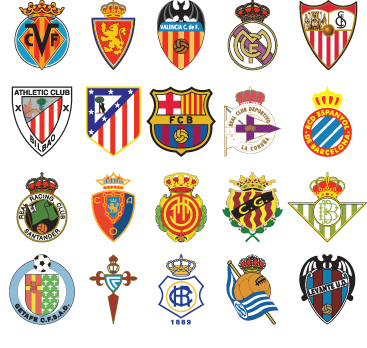
The escudos of Spain's 20 professional
"primera división" teams in 2010.
Reading Hemingway, you'd think the national pastime in Spain is bullfighting. It's not. It is soccer (a.k.a. football, "fútbol"), and in a big way. In fact, to all you American tourists planning your trip to Spain, feel free to skip the queasy bullfight experience and buy tickets to a professional soccer match. You will come much closer to the "vitality" Hemingway described in his chronicles of Spain.

I grew up on soccer in the States, so you'd think I'd be tickled pink to come to Spain, where soccer is king, constantly in the news, and indeed where the biggest news of the last ten years in the country is easily Spain's winning the World Cup in 2010. (Yes, in my personal opinion that news trumps all the economic crisis news the foreign press seems obsessed with reporting.) But I have to confess, soccer mania here quickly tapped my fan capacity. The soccer season never ends! They are always playing it! Or so it seems to me, the American used to seasonal rotations between sports: baseball in the spring and summer, (American) football, basketball, and hockey in the fall and winter. Here, there is pretty much only one sport that ever gets news coverage. All the others are just a footnote to the soccer coverage. (Just this morning on Radio Nacional de España, RNE, Pepa Fernández made a similar comment, noting that the two gold medals won by Mireia Belmonte in the European Short Course Swimming Championship only received a minute of coverage, compared to the hours and days of coverage for "El Clásico," before the game has even happened!)

Spain's victorious National selection at the 2010 FIFA World Cup.

One surprising trend with Spain's success in the 2010 World Cup was the appearance of
Spanish flags on balconies. This kind of visible popular pride in nation hadn't been seen
here _across the country's different regions_ since the Franco dictatorship.
The country really unified behind the National Selection.

That said, whether or not you like the game, if you want to follow daily conversation on the street, following the soccer league results is right there alongside reading one of the daily newspapers as the best way to integrate into the local social life. (The only other sport Spaniards like to talk about as much or more than soccer is politics.) To help you understand why it seems to always be soccer time in Spain, it helps to understand the different leagues and their seasons, and where they fit into the weekly soccer news cycle. 

There are four different category of leagues, listed here in order of global to local significance:

World:
Fédération Internationale de Football Association (FIFA) – Confederations competition, European Cup, and World Cup
    a) "La selección nacional" – Spain's flagship national team
    b) "Sub-21" – Players under the age of 21
    c) "Femenino" – Women's league

Europe:
Union of European Football Associations ("La UEFA") – European professional leagues
    a) "La Liga de Campeones" (Champion's league) – Professional teams, 1st tier European elimination contest [Here you find Real Madrid, Barça, Valencia, Villareal]
    b) "La Liga Europa" (Europa League) – Professional teams, 2nd tier European elimination contest [Here, from Spain, Athletic de Bilbao and Atlético de Madrid]

Spain:
The Spanish national league, "La Liga" – Spain's professional teams
    a) Primera división (e.g. Barça, Real Madrid, Valencia)
    b) Segunda división (e.g. Girona, Elche, Deportivo La Coruña)
    c) Segunda B (e.g. Lugo, Real Madrid II, Getafe II)
"La Copa del Rey" (King's Cup) – Spain's elimination contest

One point of confusion which can result from this multi-tiered league system is that Team X and Team Y can play one night for the Spanish league and have one outcome, and then play another night the same week or later for the Copa del Rey or European Champion's and have another outcome, the one not impacting their rank in the other contest. Which is to say that, according to my friend and informant for this entry, it is not uncommon for top teams like Real Madrid to play their lesser players in Copa del Rey games if it means having them rested and ready for the more serious competitions at the Spanish League or European Champions. (This is how my Real Madrid fan friend explains to me why my team Valencia was able to beat his team in the Copa del Rey one year, even when Valencia struggles to qualify in the European Champion's League… hmm, I see.)


To get a sense of how this patchwork of leagues plays out as a soccer routine, let's outline the weekly and annual schedules.

• The weekly schedule:

It was once the case that Spanish league games ("partidos") happened on Saturdays and Sundays, National Selection Games on Friday or Tuesday nights (but not very frequently), Copa del Rey games and Champion's League games on Tuesday through Thursday, such that Mondays and most Fridays were rest days…

This is no longer the case. Now on Monday nights they are starting to have Primera División matches, and the Segunda División games have spilled over into Fridays. The result is this weekly layout:

Monday night:                          Primera División match [this is a new experimental thing]
Tuesday night:                         Champion's League matches, Copa del Rey matches
Wednesday night:                    Champion's League matches, Copa del Rey matches
Thursday night:                        Europa League matches, Copa del Rey matches
Friday night:                             Segunda División matches
Saturday afternoon & night:    Primera and Segunda División matches
Sunday afternoon & night:      Primera and Segunda División matches

• The annual calendar is slightly more complicated to explain:

"La supercopa de España," a playoff between the top team of La Liga and the winner of La Copa del Rey the previous year, starts off the Spanish league season in mid August. This past August (2011) it was a showdown between Real Madrid CF and FC Barcelona (a.k.a. "Barça"), Spain's two top teams, a match up known as "El Clásico". (This evening, Saturday, December 11th, there is another "Clásico", the first of the Spanish regular season.) Following this Super Cup, the various leagues' seasons get underway.


Here you have the calendar for the various different leagues:

August – October: First 3 rounds of elimination games for Copa del Rey, for Segunda División and Segunda B teams
September – December: La Liga "Jornadas" (weekly round), games 1–18 (a.k.a. "primera vuelta")
November – December: "Round of 32" eliminations for Copa del Rey, now including Primera División teams
January – May: La Liga Jornadas, games 19–38 (a.k.a. "segunda vuelta")
January: "Round of 16" & "Quarterfinals" eliminations for Copa del Rey
February: "Semifinals" eliminations for Copa del Rey
End of May: Final for Copa del Rey

For the elimination contests ("eliminatorias", i.e. Copa del Rey and UEFA European contests), the trend is more games at the start of the seasons (August, September), and then tapering off as more and more teams are eliminated in each phase ("fase"). In the European eliminations, the top two teams in each group (of four) in the Champion's League, at the end of the first phase, advance to the next round. The third ranked team, however, is relegated to the 2nd tier contest of the Europa League, to join the other teams who passed out of their first phase. (Valencia CF, for example, was just eliminated from the European Champion's League at the end of the first phase, and will now be relegated to the Europa League underway... where Club Atlético de Madrid advanced and could be a competitor in this contest.)

Two styles of leadership: the cool and calm presence of Vicente del Bosque (left),
coach for the National Selection, versus the wild antics of José Mourinho (right),
the current coach of Real Madrid CF.

The national league system is much more complicated, though also more fun to follow week-to-week. All first and second division teams are ranked based on their wins ("partidos ganados" – 3 points), losses ("partidos perdidos" – 0 points), tied games ("empates" – 1 point), and points scored ("goles" – not counted unless two teams are tied in points, in which case the team with the most goals is ranked higher*). The top four teams at the end of the season automatically qualify for the UEFA Champion's League the next year. Seeds fifth and sixth qualify for the UEFA Europa League playoffs. Another kind of contest also takes place at the bottom of the Primera División chart, and the top of the Segunda División. The bottom 3 teams of the First Division at the end of the season are relegated down to the Second Division. The top 2 teams of Second division move up automatically, while the four teams ranked 3rd through 6th hold an elimination for the third spot to ascend to Primera División.

The two most prominent players in the Spanish league (and arguably in the world):
Lionel Messi of Barça (left) and Cristiano Ronaldo of Real Madrid (right). They're
such regulars on the news here in Spain, that you might not realize that neither of
them is Spanish (Messi is Argentinian, Ronaldo Portuguese). (Indeed, a recent story on
a Spanish citizenship test in Barcelona revealed that some immigrants mistakenly
listed these two players when asked to name two Spanish soccer players.
)

One nice feature about the national league double jeopardy system here is that, at the end of the season, even when the league winners have been determined, there can still be another month or so of intense fan interest in the games between the bottom six teams. (This is good because usually Real Madrid and Barça lock in the top two seats early on.) You still have these bottom teams (and all their fans) duking it out to make sure they aren't demoted to the second tier division, and the third through sixth ranked teams in the Second Division with high hopes to move up and playing off in an elimination series (usually played in June or July).

I personally like the El País soccer widget for following the Spanish League.
Here you can see the arrows up on the top 4 and 6 teams.

But just when you think the summer has come, and _finally_ you get a break from soccer, there are… 1) friendly matches "amistosos" between the various top teams (Barça & Real Madrid) or the Liga Española with teams in foreign countries, or 2) a European Championship or a World Cup (both, alternating, every two years), ensuring that there continues to be more soccer games and media commentary running through June and July. Not to mention all the intense news coverage and speculation over the soccer players' latest haircut (sure to be the next craze among boys ages 12-21), whomever they are dating and (in theory) starting to get serious about, or where they've decided to vacation this summer. (How can the 1-hour segment of daily national news always manage to dedicate 20 minutes to soccer? Nadal is lucky if he gets 5 minutes after a Grand Slam victory.)

My personal favorite Spanish soccer player right now is neither Messi or Ronaldo, but rather David Villa.
While he broke my heart when he left Valencia CF for Barça two years ago, I still think he's an awesome
talent, and without the showiness of many other top players.

Sigh. I think it is a waste of time fighting this big business fanaticism, but the constant coverage can certainly burn one out. (At least Spanish soccer fans almost never elevate their soccer mania to violence, as occurs in many other countries... hooligans anyone?) If you start to pay attention, however, the skill of play in Spain's professional league is really quite amazing. For the moment, I've hit upon a personal compromise, which keeps me in the loop without monopolizing my time: 
1) I follow the National Team (and always root for them, though remain "neutral" if they ever play the USA),
2) I follow the major games that my two local teams Valencia or Levante play, i.e. against Real Madrid and Barça (and I _always_ root for Valencia!), and
3) I follow the occasional European champion's league game if it features important Spanish team X versus important German, English, Italian, or French team Y (which are the other major European country leagues)… and I _always_ root for the Spanish team… even Real Madrid and Barça, whom I would _never_ support in the local Spanish league.
(Question to all you very partisan Spaniards out there: how can you possibly root _against_ the Spanish team when it plays against an English one in the European champions league? Really? I don't care if it's Real Madrid or Barça, is it so hard to show a little bit of national solidarity when the teams go abroad?)

This man, Iker Casillas, has become a fixture of Spanish soccer. He's been the goalie for the
National Selection for over a decade, and the captain since 2006. He plays for Real Madrid CF.

Andrés Iniesta is probably, symbolically at least, the national favorite of Spanish soccer players,
not least of all because he scored the winning goal at the 2010 World Cup Final. But also because of his
team spirit and kind-heartedness. This photo taken right after his goal shows him displaying a shirt
with the message, "Dani Jarque: siempre con nosotros" ["Dani Jarque: always with us"], in memory of his
fellow Spanish teammate who passed away the year before of a heart attack. What's more, Iniesta's small-
town roots, from Fuentealbilla, and humble personality make him a winning representative for Spain.

Whatever you think of soccer, I recommend to all expats that you try and find some way to stay one top of the soccer news. After politics, and the economic crisis, chances are that soccer is the subject everyone around you is talking about. So it can really help you to follow local conversations, events, and humor.


*In some cases, the ranking is actually more complicated than this. In case of tied points on ranking: 1) the team with more points scored directly against the tied team is ranked higher, 2) if they are still tied, then goals start to count... first the goals actually scored between them in their two seasonal games, 3) if there is still a tie (heaven forbid), then it is broken by whomever scored more goals over the entire season... and if there is still a tie then hell freezes over and anarchy reigns on earth. No, seriously, at that point, who knows what happens?


Non-exhaustive list of useful soccer vocabulary:

soccer ball: balón
throw-in: saque de banda
corner kick: saque de esquina
goal kick: saque de puerta
goal: puerta/portería
bench: banquillo
to pass: pasar
header: cabezazo
shot at the goal: tiro a puerta
goal: gol
score a goal: meter un gol
offsides: fuera de juego
injured player: jugador lesionado
foul: falta
penalty kick: penalti
goalie: portero
forward: delantero
midfield player: centrocampista
defender: defensa
linesman: juez de línea
referee: árbitro
card (yellow, red): tarjeta (amarilla, roja)
first/second half: primer/segundo tiempo
extra time: prórroga
highest goal scorer: "pichichi" [named for Rafael Moreno "Pichichi", Athletic Bilbao player 1910s-1920s]
least scored-on goalie: "Zamora" [named for Spain's still legendary goalie, Ricardo Zamora]

December 7, 2011

Pueblos con encanto: Linares de Mora and the Sierra de Gúdar

A couple of years ago El País-Aguilar published a really nice book called "Rutas con encanto (por España)," which describes some routes through rural Spain where you can find beautiful towns and countryside. Inspired by this guide's name, and fortunate to have a family in Spain that loves to do such day trips in and around Valencia, I'm starting a series of entries, "Pueblos con encanto" (towns with a certain charm), on some of the beautiful little towns I've visited, and which Hemingway never managed to get around to visiting or mentioning in his travels here.

This last weekend we went hiking in the Sierra de Gúdar and then had lunch in Linares de Mora, a small town of about 300 people (which grows to 1500 in the summer) in Teruel (Aragón). (They're both about a one and a half hour drive from Valencia.) It was a lovely trip, and I took a ton of photos. So this entry is going to be more of a photo post than a long written exposition.

We started off foraging along a forest trail on a turnoff about 10 kilometers from Linares de Mora, in the Sierra de Gúdar. The most striking (and beautiful) feature of this area is its dark red soil..


The altitude was high enough, and winter close enough, that we encountered snow on the ground in certain shaded areas.


It was hunting season. We saw hunters pulling over along the roads at various points, heard a gun shot, and saw this sign "Coto deportivo de caza" (hunting preserve) put up at regular intervals along the trails, where fences kept daytrippers like us out.


We were hunting for something different. My wife and mother-in-law wanted to make some Christmas decorations, such as wreaths, using some pine tree materials, brush, and other seasonal flora common in this area.


After hiking for a couple of hours, we were quite hungry, and ready for a meal in Linares de Mora, shown below marked by the statue to the patron saint of roads, San Cristobal, with the great motto: "Lo importante es llegar" (the most important thing is to arrive). My in-laws knew a great place there: Hostal Restaurante La Venta. We rushed to the town so as to get some "pan de pueblo" from the local horno, since small-town bakeries are renowned for their bread.


Then we walked over to La Venta for our lunch. It was Sunday, so we reserved a table in advance (which I recommend you do if you are visiting there on the weekends or holidays).


In the entryway they had a display of local mushrooms... hunting for mushrooms is another common thing to do in this region around October and November. This is why, during this season, I make a point of ordering everything on the menu which has wild mushrooms ("setas") in it.


Everything on their menu is great... we've come here several times and tried a wide variety of dishes. Here I'll just post the ones I had this time... revuelto de setas (wild mushrooms in scrambled eggs), bistec a la brasa, and the amazing "postre casero" (homemade dessert) shown below.


In what was a very classy finale to the meal, the chef brought us "miel sobre hojuelas"(fried leaves with honey on top), which is not only quite tasty but also a very old, classic dish. As my father-in-law explained there is even a line in Cervantes's masterpiece about it (the true test of Spanish authenticity): "Esto me parece argado sobre argado, y no miel sobre hojuelas" [transl.: This [business] seems to me a tangle upon a tangle, not honey over leaves.], where argado sobre argado would signify 'not straightforward' in contrast to miel sobre hojuelas which would metaphorically be 'something that is easy or going well'.


Stuffed with delicious and hearty food, the next most natural thing to do is stroll through the town. It has many of the usual features of a picturesque Spanish town: narrow cobblestone roads, houses with simple, yet pretty windows or balconies, a nice church and/or church tower, and comfortable lazy-looking cats.


The town had one additional feature which makes it worth a visit, a beautiful backdrop of hills tiered with old stone walls, probably part of some earlier agricultural era, though still inhabited by grazing farm animals throughout the area.


It was a lovely day out with the family, and one of the best ways to get to know a more peaceful and comparatively hidden side of Spain.

And you can modify this kind of weekend day trip routine for any number of Spanish towns:
1) get up early and drive to destination
2) go hiking or foraging mid morning along some local nature trail,
3) get to small town no later than 1PM to buy bread/regional pastries at the horno
4) have a big and hearty lunch in at the main eatery in town
5) stroll around the town, enjoy its particular charm (and if it's Saturday, be sure to support the local shops and purchase something)
6) drive back home feeling relaxed and contented.
It's a winning combination, and a way to see a different kind of Spain from the usual Madrid-Barcelona-Andalucía-Pamplona path.

Addendum: So obviously I'm not the first to think of visiting small towns like this, but apparently I'm not even the first to come up with this title. In the process of writing this entry, I discovered a nice website for "Pueblos con encanto" with information (in Spanish) on nice towns throughout Spain. This kind of rural tourism is quite popular with Spaniards, so I can't more highly recommend it to all you expats!

December 5, 2011

That Perfect Gift: LaTienda.com and the Food Gift-Package

There is no better gift than indulging an expat's nostalgia. So one very nice gift for those Spanish expats living in the States, or for those American friends or family recently back from study abroad in Spain, is a food gift basket from LaTienda.com.

When my wife and I were living in the U.S. for many years, LaTienda.com was a real treat. Many of the ingredients needed to make basic Spanish Valencian dishes, like "Bomba" rice for paella, are not easy to find in U.S. supermarkets. LaTienda.com was a means by which we could secure them. Also, once my wife's Spanish parents discovered the website, a surprise package of Spanish foods arriving by mail became a regular fixture around birthdays or during tough periods when nothing but food from home could comfort us. (Janet Mendel's blog, My Spanish Kitchen, has a nice entry describing the history of La Tienda as a family business started in the 1990s that soon went online.)

A romantic tapas birthday dinner we had one year thanks to
a pleasant surprise in the mail from my wife's parents.

So why not make Spanish food products a great gift this Christmas, and there are many foods to choose from… Queso Manchego, Jamón Serrano, Chocolate Valor, Piquillo Peppers, Arroz "Bomba", those large pickled Caperberries… or that Christmas classic sweet, Turrón! Those are just some of my personal suggestions. If you don't trust me, you can peruse American foodie blogs. You'll find plenty of posts about Spanish dishes, ingredients, and how wonderful it is that LaTienda brings the Spanish pantry to you.


These Spanish basics helped me get through a rough period.
Nothing cures low spirits quite like a taste from home.

This "Paella Kit" has everything
you need to make paella at home
in the States... just add water.

And you'll want to dress it up with some Spanish wine. You can find Spanish wines at LaTienda, especially useful if you are having it delivered to that loved one you can't see over the holidays. If this is for someone in the same town as you, I suspect you can just duck into your local wine shop or supermarket and find a decent Spanish label wine for cheaper. I recommend a Penedés white, though I suppose the Rioja red is the famous one.

Apparently LaTienda.com now has a European branch, so now you can also send these Spanish goodies to all those expats and Hispanophiles in Great Britain, Germany, France, Italy…

¡Buen provecho!

December 2, 2011

Jamón, Jamón

I have come to associate the Christmas season with Spanish ham, or "jamón". This is because it is quite common for Spaniards to gift each other "un jamón" (i.e. the leg or "pata" of ham) for Xmas, particularly as a professional holiday gift. For example, in many schools it is common for the parents of students to pitch in together and buy the teacher a food gift basket that includes a jamón. My mother-in-law, herself an elementary school teacher, usually gets one each year, making it part of the household tradition to be slicing "fresh" cuts of jamón for the weeks around and after Xmas. (We also start pulling out all the recipes which use jamón as a garnish, like habas beans sauté with garlic and ham, or panini-style jamón y queso sandwiches.) For this reason, you will probably be seeing more and more legs of ham hanging in your markets and supermarkets in the weeks to come as vendors anticipate this holiday demand.

A typical Christmas thank you package from my mother-in-law's elementary school students.

One of the many seasonal joys of the Christmas holiday in Spain, slices of jamón at the in-law's

Just ask Penelope Cruz, what
is more Spanish than tortilla de
patatas con cebolla
and jamón?
Most Americans and Brits who come to Spain are aware that Spanish jamón is highly prized here and quite reputed. I'll add my voice to the chorus call that it is delicious and well worth trying, whatever your feelings are about pork. If Spaniards are a bit crazed about pork, Americans are oddly sheepish (pardon the pun) about it. For Americans, pork tends to be sausages, bacon, pepperoni, sliced ham for sandwiches… and occasionally "the other white meat" (i.e. pork chops). It's thought of as a fatty or salty meat. The health conscious therefore often avoid it, and many who would gladly down a burger or fried chicken might have a peculiar policy of steering clear of it...

Which reminds me of a personal story. I had an American friend stay with me in Spain ten years ago, who joined us and our friends on a night out clubbing. Predictably the night started with a tapas dinner, and a friend of a friend at the dinner table, eager and proud to share his culture with this foreign guest, encouraged him to try the jamón serrano, and was startled when my friend resisted…
Spaniard: Try the jamón, it's delicious!
American Friend: Oh, no thank you. I don't eat pork.
Spaniard: Why? Are you vegetarian?
American Friend: No, I'm not a vegetarian.
Sp: Are you jewish?
AF: No, it's not that.
Sp [Now shoving the plate in his face]: Then why not try it? It really is good.
Me (intervening): Yeah, [AF], you really should try it. It's nothing like the pork from back home.
AF: I just don't eat pork. I don't like it.
Sp [now really confused and insistent]: No, it's really good. It won't hurt you. You should try it!
AF [awkwardly tries to change the subject]: So what is that dish...
Me [grinning at the whole experience]
So I'll repeat it, jamón really is nothing like any of the pork products we find back in the States. For Spaniards, pork might be cochinillo asado, sausages ("longanizas", "chorizo" or other "embutido"), or pork chops ("chuletas"), and cuts or sliced ham ("fiambre"), but first and foremost it is jamón, the cured, dried ham, usually encountered in thin slices. In 2009 alone, Spaniards consumed almost 21 million kilos of jamón ibérico, and one culinary blogger convincingly argues that "hay un jamón ibérico a tu medida" (there is a ham that fits each person's taste).

And it has reached such a mystique that certain quality cuts are even popularly considered to be health-promoting. My mother-in-law claims her doctor once said that "the good jamón" (i.e. the jamón de Jabugo, discussed below) shouldn't be a concern for raising her blood pressure or cholesterol… and would even lower it! A reputed Spanish nutritionist, Francisco Grande Covián, was known to say that the Iberian pig was "un olivo con cuatro patas" [an olive tree with four legs], as if to say it was as healthy to consume as olive oil.

You'll find jamón served in sandwiches ("bocadillos"), used as a flavor garnish ("guarnición") in dishes or tapas (like croquetas de jamón, yum!), or, most commonly, served in slices to be eaten on its own or with bread or cheese. (Warning Note: A "bocadillo de jamón (y queso)" _always_ refers to jamón ibérico or serrano on a baguette-style bread; however, "un mixto" has "jamón York", which is Spanish for the kind of uncured soft ham more commonly encountered in the US and UK, and is served on "pan de molde", i.e. sliced soft bread.)

Different kinds of ibérico Spanish hams, in this case all from Guijuelo in Salamanca

While everyone talks about Spanish ham, often in fairly general terms, it's important to realize that there are some important categories and distinctions to jamón. Here I'll try and sketch out the different kinds of jamón products, in case so far they've all just blurred together as 'sliced, cured ham on a platter' to you.

There is a major division drawn between jamón ibérico (the superior) versus jamón serrano (still good, but for more routine consumption). When Grande Covián or my mother-in-law talk about the magically healthful jamón, they are talking about "jamón ibérico", and more specifically about the "jamón ibérico de bellota". The pigs destined for this market are fed exclusively acorns ("bellotas"), left to roam wild, are predominantly the cerdo ibérico breed known as "pata negra", called such because of the breed's characteristic "black legs". Looser (and lesser) production grades of jamón ibérico are the "jamón ibérico de recebo" (acorns and pasture fed) and then the "jamón ibérico de cebo" (grain fed). This last one is what people are usually referring to when they say "jamón ibérico" unless they specify otherwise. In all cases the ham is dried and cured for anywhere between 8 to 36 months. For these superior hams, there are several denominaciones de origen (D.O.) regional labels: the "Jamón de Jabugo", which is produced around the town Jabugo in the sierra de Huelva, and Jamón Ibérico Guijuelo produced around Guijuelo in Salamanca are the two most famous ones; and then there are also D.O. for some hams produced in Los Pedroches in the province of Córdoba and for "Dehesa de Extremadura" in the provinces of Cáceres and Badajoz.

This image highlights the four categories or labels for jamón ibérico, based on looser to stricter
degrees of controls on feed types (grain, field grain, grain and acorn, and acorn)

The famous "pata negra" cerdo ibérico, visibly black.

The cerdo ibérico left to graze for acorns (bellota) and possibly grains (recebo, cebo de campo) in Extremadura

Jamón serrano (which literally means "mountain ham," and is because the drying sheds, secadores, are usually built at higher elevation; this ham is also sometimes referred to simply as "jamón curado") is still pretty darn good, but is less the gourmet's jamón, and more the gourmand's, what one consumes day-to-day or at their local bar. This jamón is made from the Landrace white pig breeds, rather than the pata negra, and it is not usually cured for as long. (Though like wine there are three degrees or denominaciones of how cured it can be: "bodega" (9-12 months), "reserva" (12-15 months), and "gran reserva" (more than 15 months). The most famous of these that I've heard people talk of is the "Jamón de Teruel," the best of which some people say rivals jamón ibérico (it was the first Spanish ham to receive a D.O.), but there is also "Jamón de Huelva" and "Jamón de Trevélez" (in Granada).

And it's obviously not just the kind of ham, but also the cut. As one Spanish blogger explains,
different cuts along the leg will have different consistencies, meatier or fattier, more and less tough.

Given this deep pride and technical elaboration, I strongly encourage you to try jamón at least once, whatever your opinion of pork might be. (Though I, of course, will understand if vegetarians, Jews, and Muslims opt not to.) Pork is excellent in Spain, and jamón king, so any opportunity you have to try it is worth taking! Particularly since, until recently (around 2008-2009), the United States didn't allow Spanish jamón to be imported, and it is still the case that you can't bring it through customs for personal consumption. (Indeed, if my in-laws accounts of U.S. Customs are typical, it seems to be a running joke among border agents at international airports to tease entering Spaniards about whether they've brought in with them illegally any jamón... which would have to be surrendered on the spot and added to the agents' personal stash.)

Interesting footnote: I know a food anthropologist in the States who's been studying a farm in North Carolina (or is it Virginia?) that raises the Spanish pata negra breed there, but with few of the intense D.O. quality controls that occur in Spain. They are sold as "heritage breed pigs".

You might also like:

Related Posts Plugin for WordPress, Blogger...