May 1, 2013

The Hemingway Paradigm Is... Hispanomanía (100th entry!)

So every 25 entries or so I take a moment to pause from generating new content for the blog and reflect on why I started it, that is, to do my part to help rupture the "Hemingway paradigm". This is my 100th entry (yay!), so I thought I would focus on a subject a Valencia twitter acquaintance of mine once posed to me, what is it with foreigners (especially Anglophones) and their particular obsession vision of Spain. It's an obsession that a Spanish-British author, Tom Burns Marañón, brilliantly named "Hispanomanía".

Obviously Ernest Hemingway, our blog patron saint, was one notable example of it: an American who came to Spain with a particular kind of Romantic vision of the country, its "authenticity", its "charm". In my 50th entry I traced it back to older roots, with Richard Ford. At some point I also hope to write an entry on "Not Washington Irving's Granada", since his book Tales from the Alhambra is a laugh for all of its vivid, fanciful stereotypes of Spaniards... doubly funny for how many of those stereotypes seem to persevere today. (Just check out my 75th entry on the "impertinente curiouso", for some present-day examples.) If you want to explore the full gamut of literary examples of this Hispanomanía, I recommend you visit the "Books on Spain" blog, Kirsty Hooper's scholarly study of the subject.

Or you can simply run a Google Image search on "Spanish culture":

Grrrr!!! Why does the paella here have red peppers!!!


For comparison (sorry, vanity couldn't resist), try running a Google Image search on "Not Hemingway's Spain":


The main difference seems to be more subdued colors and less bull shit imagery.

One of the things this Valencian twitter friend said to me, which I'm inclined to agree with, is that Burns Marañon's description of Hispanomanía tends to focus too narrowly on the North-South interior axis (Pamplona-Madrid-Andalucía), but ignores the equally important, more contemporary East coast axis (Barcelona-Alicante-Málaga... an axis that somehow skips over Valencia!). Today, it is not just Hemingway/Lorca thrill-seekers who come to Spain, looking for that exotic, mysterious Romantic past, but also the beach bums and hedonists wanting their fun-in-the-sun and that "laid back" culture they associate with the Spanish Mediterranean way of life.

I'm still convinced that one of the best visual documentations of what is "profoundly Spanish",
albeit in a Romanticized, nostalgic vein, was the early 20th-century painting expedition
by (Valencian) painter Joaquín Sorolla, sponsored by the Hispanic Society of America.


Some of Sorolla's most beloved works, at least with Valencian locals,
are his pictures of people (particularly kids) on the seaside beach.

Sorolla's contemporary, the American painter John Singer Sargent, captured perhaps
the best rendition of Hispanophiles' quintessential image of Romantic Spain, the flamenco dancer.

At one point I sat down and started to brainstorm a list of what exactly would Hispanomanía look like in Hemingway's time versus what it would look like today:
Then:  
Bulls, red bandanas, castanets, flamenco dancing, gypsies, frill dresses, dark eyes, dark hair, thick lisp, blood, roast pig, Iberian ham, bullfights, matadors, Pamplona, "Olé", siesta, fiesta, hot-tempered, machista, sherry, red wine, picaresque, the Spanish Civil War, Don Quixote, Cervantes, Madrid, Sevilla, Andalucía, Granada, Ronda, castles, warm weather, sunny, arid landscapes, conquistadors, windmills, the Spanish Inquisition, Catholicism, cathedrals, 1492, civil strife…
Now
Beaches, warm weather, Málaga, Ibiza, the "Costas", sangría, nightclubs, economic crisis, corruption, PIGS, soccer, Barcelona, Gaudí, Dalí, Almodóvar, Lorca, Camino de Santiago, the Mediterranean diet, paella, gazpacho, cava, tortilla de patatas, the running of the bulls, Hemingway, la Tomatina, Hispanidad, Semana Santa, study abroad, TEFL, Feria de Abril, German tourists, British tourists
Some things haven't changed, and would make the list both then and now. Though I think what was once seen to be deeply rooted and deeply "Spanish" (Catholicism, "las dos Españas") has been transformed, with the rise of the consumer(ist) society, and is now consumed (by foreigners and locals alike) in a lighter, more fanciful form (Semana Santa festivals, "el clásico" football rivalries).

I've never heard an Hispanophile go on and on about the Aragón "jota" dance
the way they do about flamenco.

I remember seeing this Sorolla depiction of Valencian life, in the Hispanic Society of America exhibit,
and thinking: "even in paintings the light in Valencia just look brighter than everywhere else".

Perhaps in my 125th or 150th entry I'll list the things about Spain that never seem to make the shortlist but should...
advanced telecommunications engineering, Spain's "brain drain", the Erasmus generation, alternative energy technologies (i.e. wind energy), Moneo, the new Spanish cuisine (Adrià, Arzak...), its nature, nature, nature, high-speed trains, FallasMudéjar ceramics, Valencia, Sorolla, Calatrava, Kukuxumusu, the Democratic transition, the Pyrenees, skiing, immigrationtennis, basketball, almonds, Álex de la Iglesiagraphic arts innovators... etc.
The future image of Hispanomanía?

April 16, 2013

Azulejomanía: Images of Sevilla Through Tile Art

I visited Sevilla on the eve of Semana Santa,
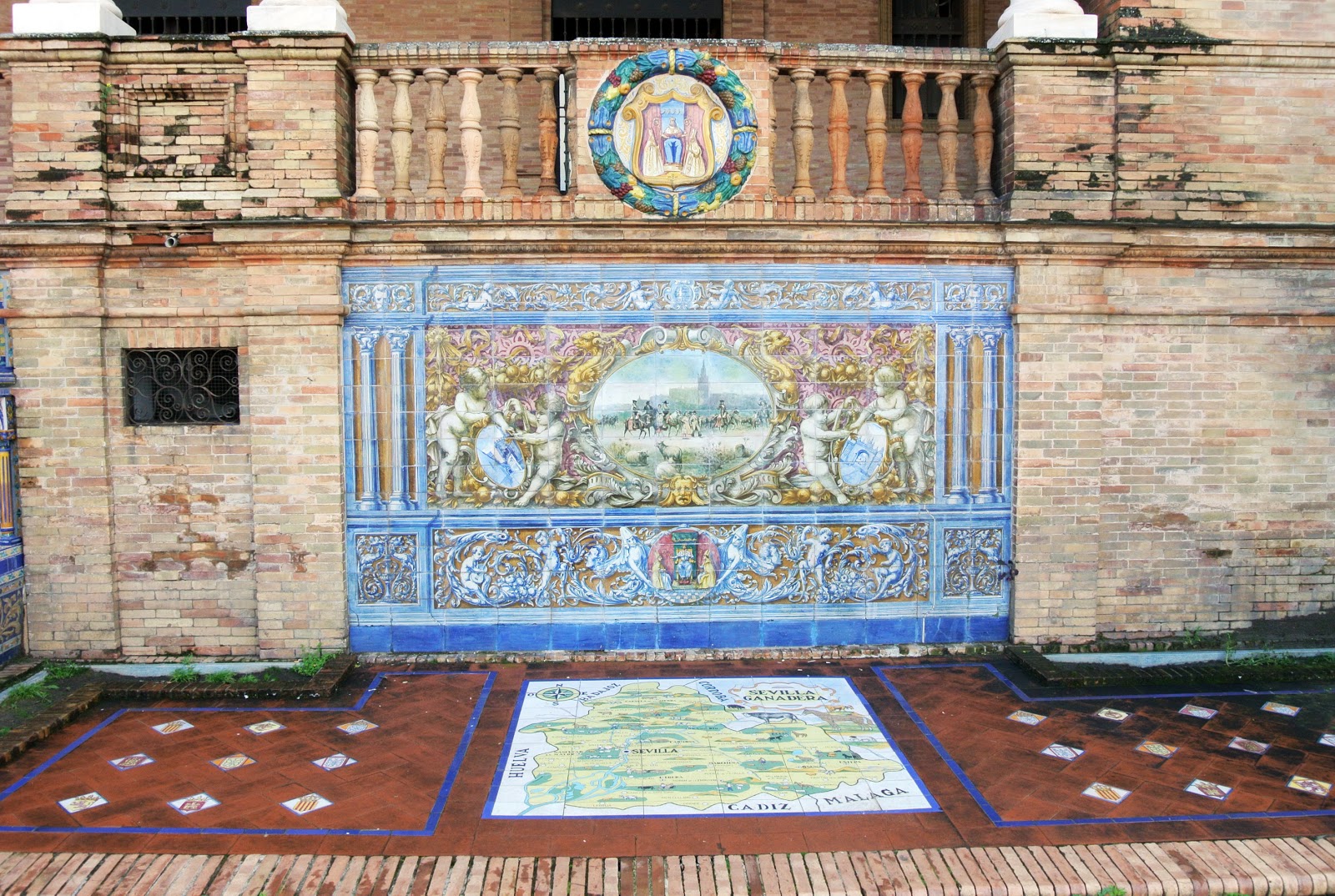
the subject of this tile display at the Plaza de España
On my recent trip to Sevilla, I was trying to think of what I might share with my readers about Spain's fourth largest city, which hasn't already been shared by dozens, upon dozens of other expat bloggers who live there. (I swear, you could throw a stone and end up hitting an expat there. Why are there disproportionately so many fewer bloggers here in Valencia?!?) The answer is, probably not much. Chic Soufflé beat me to the punch on the excellent tapeo opportunities, and our blogger friend Delikat Essences has more than provided the be-all, end-all visitor's guide (in Spanish): part 1 and part 2. (She was an excellent local guide. Many thanks!) So instead I thought I would share my experience of the city through one of my personal obsessions passions: tiles ("azulejos").

I first got interested in tile art because Valencia has a tradition of it. But, in truth, many places in Europe have this tradition. Sevilla, however, is interesting and distinctive because it has really embraced it. Tiles are everywhere! As you wander through the city and its famous tourist sights, it seems like every feature of life and culture there has, at some point, in some way, been refracted through a depiction that was burnt or painted onto a tile. Much like my obsession with pomegranate iconography in Granada, I pretty quickly caught a bad case of azulejomanía.

Here, in honor of Sevilla's "Feria de Abril" which commences tonight, I share with you some images of the city, as seen through its tiles...

Real Alcázar:
The presence and importance of the Real Alcázar, a magnificent fort built during the Moorish occupation of the city (712-1248), is clearly what inspires the long, sustained local tradition and interest in tile art. So it's a good starting point for our tile tour.


Much like the Alhambra in Granada or the Mezquita in Córdoba, a defining
feature of the Real Alcázar was its distinctive Moorish, in this case Mudéjar style.

These green tiles were clearly the signature pattern for the Alcázar.


Okay, it's not tiles, but the ceiling of the Hall of Ambassadors is beautiful!

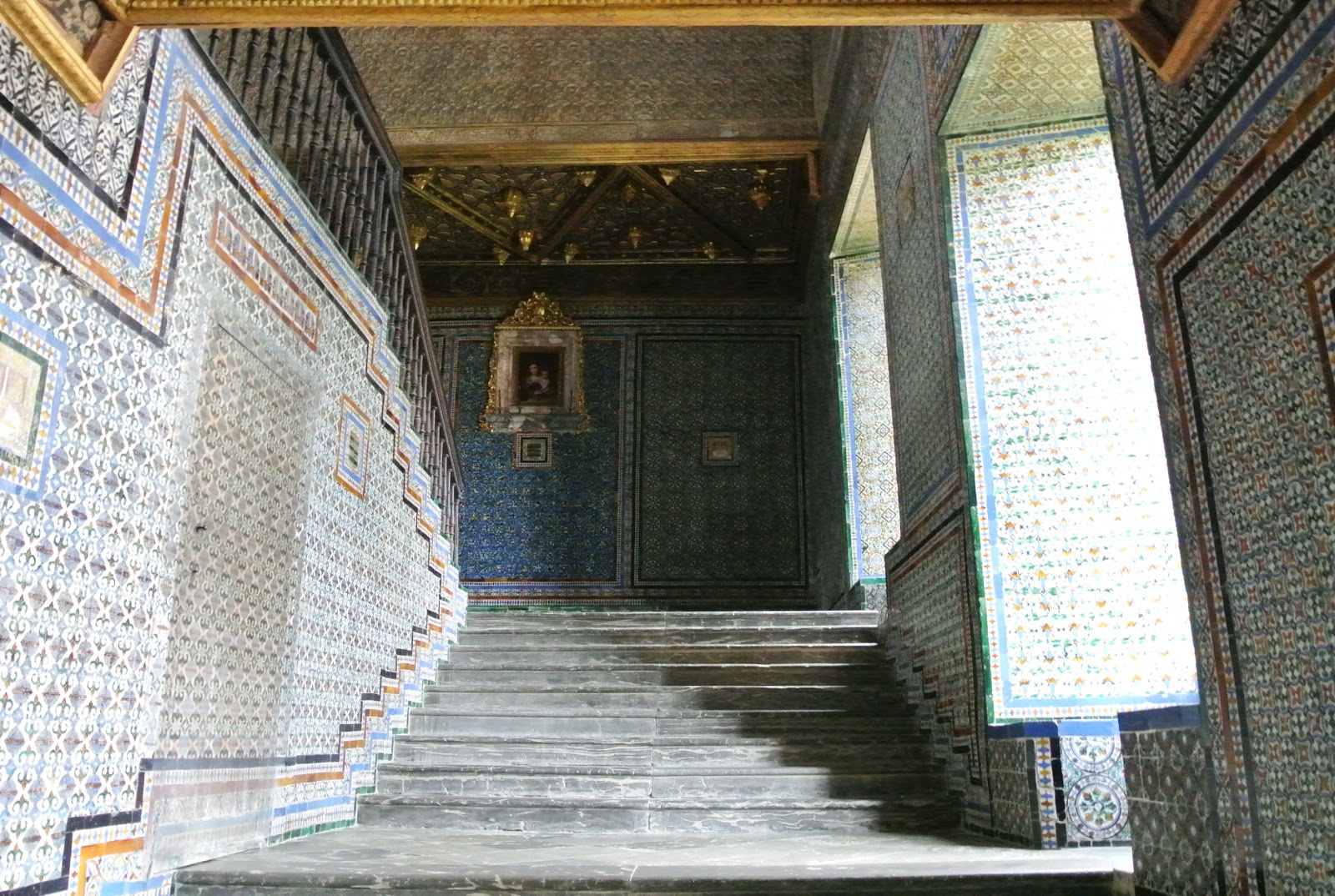
I particularly liked this blue tiled staircase!


The gardens were pretty magnificent...

... and had more tiles!


"Plus Ultra", Latin for "further beyond", motto of Rey Carlos V and of Spain today.

Digression, a fun game: One of the photos above isn't actually from Sevilla, but was instead taken during my recent visit to Istanbul. Can you guess which one? It was really interesting to compare the fusion of East meets West in Sevilla (and Córdoba) with that of Istanbul was Constantinople, been a long time gone… Maybe I'll write an entry on that later.


Virgin Tile Iconography:
So did you know that Spain is a Catholic country? No? Well, let me tell you… Okay, I'm clearly being facetious here, but it was pretty overwhelming striking to see the frequency of religious tile displays all over the city. (Yeah, Valencia has them, too, but not nearly so much.) One can see that the church and its signature local festival, Semana Santa, has a greater visibility here than other places in Spain. Even if you're not especially into the religious iconography, it is difficult to not appreciate the detail, beauty, and variety of these many Virgin and Catholic tile displays.


La Cartuja & Plaza de España:
Two other important stops on our tile tour are La Cartuja, which was at one point in time actually a ceramics factory, though today acts as a contemporary art exhibit space, and the renowned Plaza de España, a faux, decorative square built in 1928 for the Ibero-American Exposition of 1929.


The only tiles you'll see at La Cartuja are in this unused entryway,
a beautiful vestige of the factory's earlier days.

These oven towers were mammoth and impressive,
and a nice industrial backdrop for a contemporary art museum.


Panoramic of the Plaza de España, which is much larger
than I had remembered it from my previous visit

Nice bridges with ceramic adornments!

Scattered throughout the regional displays were special displays
on the cultural highlights of Sevilla.


Even tile maps of (1928) Sevilla's landmarks and neighborhoods.


But the true touristy brilliance of Plaza de España are the opportunities it
provides visitors to snap a photo with the display for their home city...
like the one for my beloved Valencia!!!


Casa de Pilatos:
This beautiful 15th-16th century palace is like a temple to the tile gods. By this point in the journey I was completely taken by azulejomanía, and took hundreds of photos of the tiles. I'll spare you that longer photo journey and only post a select six here. Let's just say it's worth a visit!


Tile heaven!


"Azahar" and the "other" orange city:
When I was considering possible quirky touristy photo games for Sevilla, one idea was to look for references to "azahar" that are all over the city. Azahar is the Spanish name for orange blossoms, and I quickly realized that Sevilla is as much an orange city as Valencia. There were orange trees everywhere, and the azahar was just starting to bloom. In the end I decided it didn't quite have the same catch as Granada's pomegranate iconography, but it was interesting how Sevilla really seemed to sell the azahar, whereas Valencia sells the orange fruit imagery.

Budding orange blossoms.


Tiled oddities, to categorize under "Miscellaneous":
And then there were all the other tile discoveries I found, some odd, some interesting, all dutifully documented by this clearly obsessive compulsive photographer.


This joint had some cool tile decoration, but I was really drooling
over its incredible collection of coffee pots!

This tile display clearly belonged to a church whose patron saint was Grouch Marx...

Being the food market junky, I couldn't pass on a visit to the Mercado de Triana.

Nice tiled dome at the Castillo de San Jorge!

I stumbled upon this bizarre, awesome tile ad throwback, which,
thanks to Delikat Essences, I now know has an interesting back history.

"Aquí vive gente de Triana", I can just hear this said with a proud
Sevillano accent by some Flamenco dancer!

I especially liked the wild tiles at El Rinconcillo, the oldest restaurant in Sevilla.


Street art, pre-Semana Santa "pasos", and, okay, other art not really at all about tiles:
Okay, so I wasn't only looking at tiles. There were plenty of other interesting eye candy and artistic mediums of expression throughout Sevilla. Here are some other things that caught my eye...

Speaking of eye candy, how adorable are these Semana Santa candy figurines!?!


Amazing street art mural including, yes, an orange tree.

This very cool shadow-like mural is apparently for a bar, Bar Antojo.
Thanks loubylou79 for letting me know!

I don't know if this was street art or an ad, but I loved it!
What a great play on the Giralda and Bull!

One of the coolest street art discoveries was learning that the Sevilla trash company
sponsors a contest for decorating the recycling containers.
The "TODOTUYO" project by cleaning company LIPASAM... Brilliant!
Again, thank you Delikat Essences for tipping me off about it.

As I said, I arrived to Sevilla on Semana Santa Eve, and much like how the weeks leading up to Fallas one can get a sneak preview of the falla displays, this meant that I could catch a preview of the amazing religious alters that would be paraded around during the religious Easter festivities the following week.


Mounting and polishing these altars was no small achievement.


So I'll add my voice to the chorus of calls hailing Sevilla as a beautiful destination to visit. We had an amazing time there and I definitely recommend it, not only for the tiles!

¡Feliz Feria de Abril!

You might also like:

Related Posts Plugin for WordPress, Blogger...