April 16, 2013

Azulejomanía: Images of Sevilla Through Tile Art

I visited Sevilla on the eve of Semana Santa,
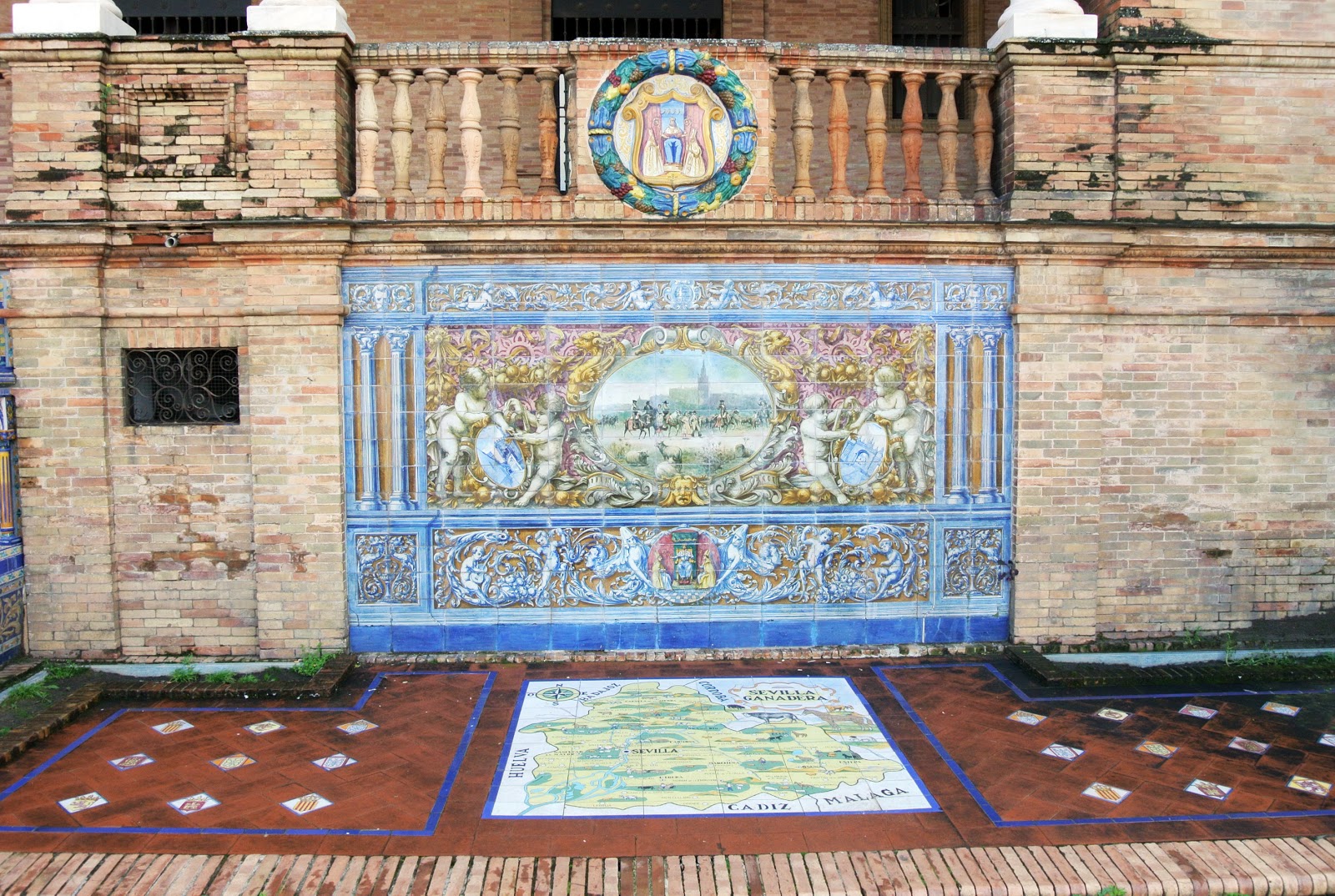
the subject of this tile display at the Plaza de España
On my recent trip to Sevilla, I was trying to think of what I might share with my readers about Spain's fourth largest city, which hasn't already been shared by dozens, upon dozens of other expat bloggers who live there. (I swear, you could throw a stone and end up hitting an expat there. Why are there disproportionately so many fewer bloggers here in Valencia?!?) The answer is, probably not much. Chic Soufflé beat me to the punch on the excellent tapeo opportunities, and our blogger friend Delikat Essences has more than provided the be-all, end-all visitor's guide (in Spanish): part 1 and part 2. (She was an excellent local guide. Many thanks!) So instead I thought I would share my experience of the city through one of my personal obsessions passions: tiles ("azulejos").

I first got interested in tile art because Valencia has a tradition of it. But, in truth, many places in Europe have this tradition. Sevilla, however, is interesting and distinctive because it has really embraced it. Tiles are everywhere! As you wander through the city and its famous tourist sights, it seems like every feature of life and culture there has, at some point, in some way, been refracted through a depiction that was burnt or painted onto a tile. Much like my obsession with pomegranate iconography in Granada, I pretty quickly caught a bad case of azulejomanía.

Here, in honor of Sevilla's "Feria de Abril" which commences tonight, I share with you some images of the city, as seen through its tiles...

Real Alcázar:
The presence and importance of the Real Alcázar, a magnificent fort built during the Moorish occupation of the city (712-1248), is clearly what inspires the long, sustained local tradition and interest in tile art. So it's a good starting point for our tile tour.


Much like the Alhambra in Granada or the Mezquita in Córdoba, a defining
feature of the Real Alcázar was its distinctive Moorish, in this case Mudéjar style.

These green tiles were clearly the signature pattern for the Alcázar.


Okay, it's not tiles, but the ceiling of the Hall of Ambassadors is beautiful!

I particularly liked this blue tiled staircase!


The gardens were pretty magnificent...

... and had more tiles!


"Plus Ultra", Latin for "further beyond", motto of Rey Carlos V and of Spain today.

Digression, a fun game: One of the photos above isn't actually from Sevilla, but was instead taken during my recent visit to Istanbul. Can you guess which one? It was really interesting to compare the fusion of East meets West in Sevilla (and Córdoba) with that of Istanbul was Constantinople, been a long time gone… Maybe I'll write an entry on that later.


Virgin Tile Iconography:
So did you know that Spain is a Catholic country? No? Well, let me tell you… Okay, I'm clearly being facetious here, but it was pretty overwhelming striking to see the frequency of religious tile displays all over the city. (Yeah, Valencia has them, too, but not nearly so much.) One can see that the church and its signature local festival, Semana Santa, has a greater visibility here than other places in Spain. Even if you're not especially into the religious iconography, it is difficult to not appreciate the detail, beauty, and variety of these many Virgin and Catholic tile displays.


La Cartuja & Plaza de España:
Two other important stops on our tile tour are La Cartuja, which was at one point in time actually a ceramics factory, though today acts as a contemporary art exhibit space, and the renowned Plaza de España, a faux, decorative square built in 1928 for the Ibero-American Exposition of 1929.


The only tiles you'll see at La Cartuja are in this unused entryway,
a beautiful vestige of the factory's earlier days.

These oven towers were mammoth and impressive,
and a nice industrial backdrop for a contemporary art museum.


Panoramic of the Plaza de España, which is much larger
than I had remembered it from my previous visit

Nice bridges with ceramic adornments!

Scattered throughout the regional displays were special displays
on the cultural highlights of Sevilla.


Even tile maps of (1928) Sevilla's landmarks and neighborhoods.


But the true touristy brilliance of Plaza de España are the opportunities it
provides visitors to snap a photo with the display for their home city...
like the one for my beloved Valencia!!!


Casa de Pilatos:
This beautiful 15th-16th century palace is like a temple to the tile gods. By this point in the journey I was completely taken by azulejomanía, and took hundreds of photos of the tiles. I'll spare you that longer photo journey and only post a select six here. Let's just say it's worth a visit!


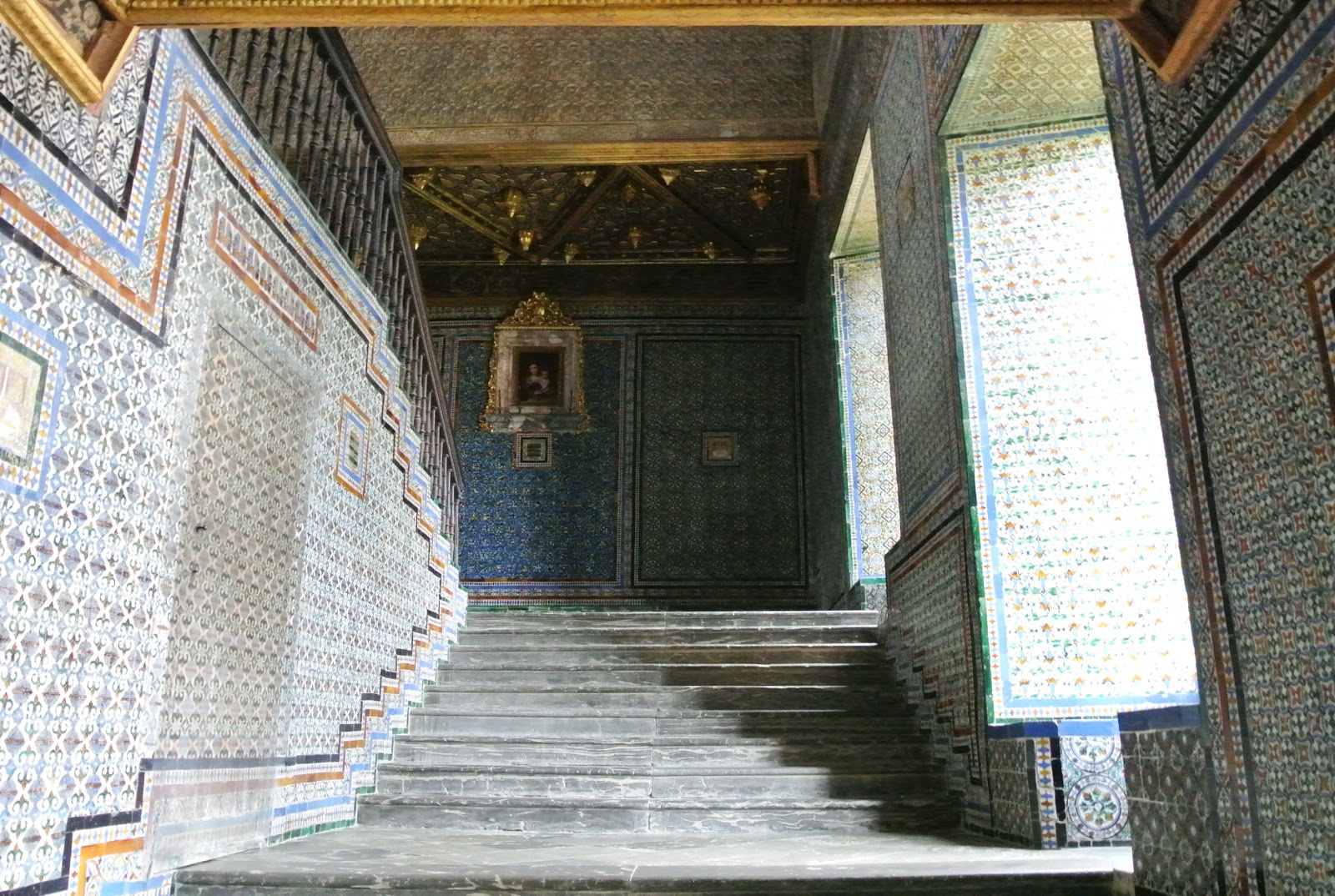

Tile heaven!


"Azahar" and the "other" orange city:
When I was considering possible quirky touristy photo games for Sevilla, one idea was to look for references to "azahar" that are all over the city. Azahar is the Spanish name for orange blossoms, and I quickly realized that Sevilla is as much an orange city as Valencia. There were orange trees everywhere, and the azahar was just starting to bloom. In the end I decided it didn't quite have the same catch as Granada's pomegranate iconography, but it was interesting how Sevilla really seemed to sell the azahar, whereas Valencia sells the orange fruit imagery.

Budding orange blossoms.


Tiled oddities, to categorize under "Miscellaneous":
And then there were all the other tile discoveries I found, some odd, some interesting, all dutifully documented by this clearly obsessive compulsive photographer.


This joint had some cool tile decoration, but I was really drooling
over its incredible collection of coffee pots!

This tile display clearly belonged to a church whose patron saint was Grouch Marx...

Being the food market junky, I couldn't pass on a visit to the Mercado de Triana.

Nice tiled dome at the Castillo de San Jorge!

I stumbled upon this bizarre, awesome tile ad throwback, which,
thanks to Delikat Essences, I now know has an interesting back history.

"Aquí vive gente de Triana", I can just hear this said with a proud
Sevillano accent by some Flamenco dancer!

I especially liked the wild tiles at El Rinconcillo, the oldest restaurant in Sevilla.


Street art, pre-Semana Santa "pasos", and, okay, other art not really at all about tiles:
Okay, so I wasn't only looking at tiles. There were plenty of other interesting eye candy and artistic mediums of expression throughout Sevilla. Here are some other things that caught my eye...

Speaking of eye candy, how adorable are these Semana Santa candy figurines!?!


Amazing street art mural including, yes, an orange tree.

This very cool shadow-like mural is apparently for a bar, Bar Antojo.
Thanks loubylou79 for letting me know!

I don't know if this was street art or an ad, but I loved it!
What a great play on the Giralda and Bull!

One of the coolest street art discoveries was learning that the Sevilla trash company
sponsors a contest for decorating the recycling containers.
The "TODOTUYO" project by cleaning company LIPASAM... Brilliant!
Again, thank you Delikat Essences for tipping me off about it.

As I said, I arrived to Sevilla on Semana Santa Eve, and much like how the weeks leading up to Fallas one can get a sneak preview of the falla displays, this meant that I could catch a preview of the amazing religious alters that would be paraded around during the religious Easter festivities the following week.


Mounting and polishing these altars was no small achievement.


So I'll add my voice to the chorus of calls hailing Sevilla as a beautiful destination to visit. We had an amazing time there and I definitely recommend it, not only for the tiles!

¡Feliz Feria de Abril!

March 24, 2013

Guest Post: "I Survived Fallas 2013!"

This year I sat Fallas out, and joined the Valencian vacation exodus, visiting Sevilla. (More on that in future posts to come.) But I didn't want my readers to miss out on the fun here. So I asked Katlyn, an exchange student from Pennsylvania who's staying in Valencia this spring, to take notes about her "first Fallas experience" and write it up for the blog. Here's her account of surviving the whirlwind ride that was Fallas 2013!
20 March 2013

This morning I woke up to the sound of the birds chirping. The streets were clean, not an empty bottle or beer can in sight. However, yesterday, just ONE day ago, the scene was quite the contrary. During the last few days of Las Fallas, I woke up to the sound of people shouting and throwing petardos (the equivalent to fire crackers) and orchestras parading along with hundreds of falleros. The city of Valencia was overflowing with culture, pride, and excitement. If Google Earth were to have taken pictures this past weekend, they would be able to see the city of Valencia illuminated by the hundreds of thousands of fireworks, fires, and lights. I am sure the noise could have been heard from outer space as well. The amount of people in Valencia doubled, and the amount of trash that accumulated in the streets, who knows? But, I’m telling you, while walking to the Plaza de la Virgen today, there was not one empty San Miguel beer can or petardo shell to prove that just a few days ago the biggest fiesta in the world was taking place in this amazing city.

Although the “official” day of Fallas began over two weeks ago with La Cridà, the real Fallas (the date where you really want to be here) begin on March 15th (La Plantá). On this day, the Fallas (a.k.a. HUGE, colorful monuments made out of Styrofoam, wood, and a lot of talent that virtually do not exist anywhere else in the world) were erected in various locations throughout the city. You can tell which barrios have a lot of money because their falla is massive and typically has more detail. Each falla is surrounded by various ninots, which are smaller structures that typically have some sort of political or pop culture connotation that goes along with them.

This was my personal favorite, located in the Plaza del Pilar
The plaza is so small, and this falla is HUGE. It is not far 

from the main public library and is definitely one worth seeing.    

This is the Falla de Convento Jerusalén, and it was nominated as the Mejor Falla de 2013.    

The falla in the center of the Plaza de Ayuntamiento.
Looks like a bunch of stereotypical tourists that you would find in
Valencia on a daily basis. Obviously, I am the blonde
American chick scarfing down the churros con chocolate.

This is a Falla Infantil because it is smaller and directed towards the younger audience.
It depicts the classic family favorite Mary Poppins, or as some Spaniards say “Marí Poppis”.

The ninot indultat of 2013. This precious gem (from Falla Na Jordana) will go
 along with the other ninots indultats in the Museo Fallero. The window in the background
had some sort of operating system that made the snow fall!

The fallas were my absolute favorite part of the entire event. During the nighttime, and after the music was cut off at 4am, many people could still be found in the streets admiring the fallas. It was absolutely admirable to see these pieces of art and to consider the amount of effort, talent, and time that goes into making them possible. It is really heartbreaking (but somewhat enjoyable!) to see them go up in flames at the end.

Some of the light displays that went up in the streets were also really impressive. In my opinion, the best and the most light displays can be found in Russafa.


Everyone was in awe at this globe of bombillas in Calle de Cuba.

I feel like I am at Disney World!

La mascletà is definitely something for those who love really, really loud noises. La mascletà is more for the sound, not for the big fireworks with a lot of colors (those are called castillos). This firework show takes place everyday during las Fallas at 2pm sharp in the Plaza de Ayuntamiento. Each day, the pirotécnico changes and the most skilled are saved for the last few days of las Fallas. Towards the last few days, you have to be in the Plaza an hour earlier in order to get a closer spot. I am not going to lie, but you have to prepare yourself to be packed in like a sardine and smell everyone’s body odor. I typically went an hour earlier and got a great spot, but only with a lot of pushing, shoving, and telling people “Mi amigo va a vomitar.” The closer you are, the more impressive the show will be. The mascletà can be seen live on TV, but nothing compares to the sensation of feeling the earthquake that is created by these traca (fireworks stringed along a line) that send pulses through your entire body. It is even more exciting to see the crowd get crazy as the noise becomes so intense that the surrounding buildings shake and your eardrums start ringing!


Probably the closest you will ever find me in a scene from Call of Duty.

I am from the United States, and just like most Americans, I love seeing the fireworks on July 4th. NOTHING can compare to the fireworks that I have seen this past week. There are fireworks to be seen every night during las Fallas. Again, if you want a good spot, you have to plan on arriving at your desired location an hour before. I preferred sitting near one of the bridges farther away (el Puente de Aragón) to be able to see the entire show and to avoid the massive surf of people leaving el Puente de Exposición. The environment before the castillos could be compared to a tailgate party. The majority of the young people could be found haciendo botellón, while the future pyros could be found with their parents throwing petardos. The most impressive show happened at 1:30 am during La Nit del Foc (March 18th). To put this spectacular show into perspective, imagine the grand finale of a firework show that lasts for 20 minutes. ¡Increíble!


... Some pics (and a video) of the AWESOME fireworks from La Nit del Foc ...


This is the last two minutes of the show from La Nit del Foc

I really could have used a pair of sunglasses and earplugs towards the end.

If you are interested in seeing una Corrida de Toros, there are many opportunities to see one during the week of Fallas. I was able to go to one, and it was quite the experience. If you want to see the traditional, what-you-had-pictured-in-your-mind corrida de toros, you have to purchase tickets for the corrida, not los recortes. They are two separate events, and almost always the corrida happens at night. Everyone will have his or her own opinions about this subject. However, I feel that there is a need to respect what is and has been a part of the Spanish culture for many years. I think my favorite part of the evening was when a group of young guys blew up an inflatable "doll” and tossed it down to the arena, expecting the matador to throw it back towards the crowd. And he did. 


The verbenas are definitely something that the Spaniards look forward to during Fallas. A verbena is an outdoor concert or DJ where everyone catches up with friends, drinks a couple (or a few more!) beers, and dances the night way. I was able to go to two verbenas, and both have gone into the “Things I don’t tell Grandma” region of the memory. My friends and I were able to find verbenas directed towards younger crowds, but there were many throughout the entire city. At one point, we ended up in a verbena that had a lovely mosh pit and some melodic dubstep. We didn’t stay there for too long. Other than that, the atmosphere was fantastic, and everyone was having a blast. By law, music had to be cut off by 4am, but the crowd doesn’t clear until well after sunrise. I called it a “morning” at around 6:30 am, but my fellow Spaniards kept chugging along and went to see some fallas and got breakfast. 


The aftermath of a great verbena! I always feel so bad for the limpiadores after I see sights like this.

As I mentioned before, parades could be heard (and seen) throughout the entire day. There were three parades that I was able to witness. On March 16th, I saw La Gran Parada Mora. This parade is very small in comparison to the others, but it is totally worth seeing. The costumes are amazing, and from what I saw, it seemed that they were worth a lot of money. In previous years, there were camels that participated in the parade, but this year the only animal was a horse that cantered and behaved very well. If you want to sit in one of the white lawn chairs, you have to pay five euros. But, you can perfectly see the parade from the street. I was lucky enough to be able to sit between two dumpsters! :-) 


Before the night of La Cremà, I recommend going to Calle Colón to see La Cabalgata del Fuego. Women dressed in traditional outfits from different parts of Spain (and Europe) led the procession, flaunting their gorgeous dresses. Then, the fun part came. Men dressed like devils were riding on bicycles that were spewing fire into the crowd. People on stilts were whipping around fireballs. Fireworks were being let off in the middle of the street. It was an awesome sight that pepped everyone up for the “burning events” of the following evening.


Could you imagine what the sidewalks of Valencia would be like if all of the Valenbisis did this?   

Definitely did not expect that!

Perhaps the most emotional part of Fallas is La Ofrenda a la Virgen. Thousands and thousands of bouquets of flowers were carried to the Plaza de la Virgen by the falleros. A week ago, a wooden structure was mounted in the Plaza with the heads of Virgin Mary and Baby Jesus. I had no idea that a week later (and TWO days of parading falleros), it would become a grandiose statue of thousands upon thousands of white, red, and yellow flowers that brought tears to the eyes. The Plaza is still covered in flowers and it is definitely an impressive, moving sight. 


La Virgen all decked out with thousands of beautiful flowers.

The back of her dress. It still amazes me that this can be done with flowers.

La Cremà is considered the closing ceremony of Las Fallas. At midnight, all of the fallas (with the exception of the falla in la Plaza de Ayuntamiento) were engulfed by flames. Before heading out, you have to choose which falla was your favorite, or the one that you think will be worth seeing burn down. We chose to see Na Jordana (aka HUGE Trojan horse). At first, I was expecting a huge explosion and I stood behind a larger man, obviously so that he could be my shrapnel shield. But, it was not like an explosion from an action film. Fireworks (Yes, more fireworks!) set off at once and the falla went up in flames. It was so HOT because it was like a giant bonfire, and the huge crowd of hundreds of people stuffed into a small plaza did not help either. But, I managed to keep my eyebrows! 


Before...

... After

Directly after the burning of Na Jordana, we headed over to the Plaza de Ayuntamiento. We then watched the burning of the falla with the all of those tourists. Just when we thought the fireworks were over and done with, the sky, once again, filled with castillos. I teared up because that signified the end of what came to be the biggest fiesta of my life. Valencia sure does know how to party!


The last hoorah of Fallas 2013   :-(

I hope everyone has enjoyed reading my post. I had an AMAZING time during Fallas, and I feel that I was able to make the most of my experience. Everyone needs to experience las Fallas at least ONCE in his or her lifetime. Here are some pointers for those of you who will be here next year:

    • Forget about public transportation. The buses cut their routes, certain streets are blocked off, and the amount of people is just insane. The fastest way to get from place to place is definitely by walking.
     • You will not look like a tourist if you wear the blue/white tartan pañuelo. The majority of the people wear them, and it is really interesting to see the various ways that people rock them. Plus, they are really cheap, and in some bars, you might be able to get one for FREE with a beer logo on it. Do not pay more than 1 euro for it if you find someone selling them in the streets!
    • Plan to not sleep. You have to try to see as much as you can. You never know if you are going to be back for the Fallas. But, taking naps between 2:30-6 will definitely help you survive through the week. 
    • The majority (if not all) stores close on March 19th (the celebration of San José). If you need to purchase food or beverages from the market, make sure to do it the day before. If not, El Corte Inglés is there to be your saving grace.
    • Keep your mouth open during la mascletà. If not, there is the chance that your eardrums will ache for the remainder of the day!
    • Be sure to eat a lot of buñuelos and 
chocolate con churros! Live it up! Try to see and do everything that you possibly can! #YOLO

Kat, wearing the Fallas pañuelo, in fiesta mode!

Happy to say that I survived Fallas 2013! I cannot wait to do it again in the future!

    —Kat

You might also like:

Related Posts Plugin for WordPress, Blogger...